Article Statistics
Have you ever wondered how bee see and how bee eye look?

Researchers studying bees have shown that even in gloomy weather, bees are able to use the sun’s UV light to locate themselves, find directions, and communicate the location of food to other bees. Additionally, bees were able to do this despite the sun’s constantly shifting position throughout the day, meaning they could calculate by utilizing the sun.
When scientists discovered how the Sun benefited bees, they started studying how to determine direction. First, the bee eye structure was investigated, and it was discovered that the bee eyes have a design that will enable these computations.

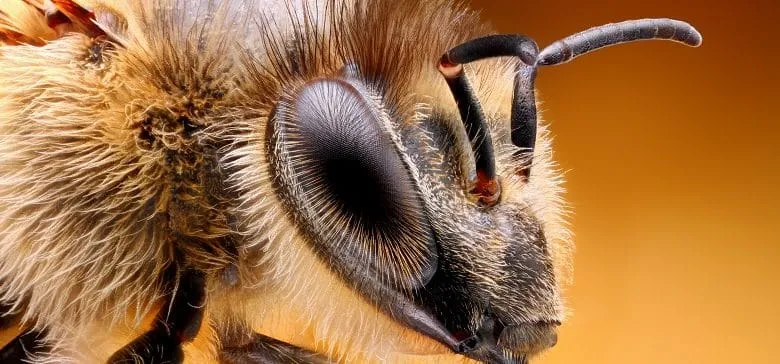
The ocular anatomy of bees is really unique. There are 6,900 distinct “ommatidia,” or components of the vision, in bee eyes. On its own, each of these components functions as an eye. Like straws in a box, they are grouped together. Additionally, each of them has an outside tiny convex lens that is clear at the end. These lenses, which resemble a glassy ellipse, make up the eye’s outer shell. In addition to the integrated eyes on both sides of the head, bees also have three basic eyes on their heads. It is assumed that the head’s parts are utilized to gauge light intensity.
Additionally, bees can take hundreds of pictures and view their full 360-degree world because of these thousands of “eyelets.” The optic nerve center, which is housed here, processes up to 70,000 images per second from all of the bee’s eyes to determine the bee’s direction and location. The bee’s visual system is ten times more effective than ours.
Two more benefits of the bee eye over the human eye include:


1- Seeing UV rays
2- break down light polarization
These characteristics provide bees the ability to fully perceive their surroundings and pinpoint the position and angle of the Sun. The bees can properly calculate the target’s direction by adjusting the recipe they will communicate to the other bees in the hive as the Sun moves across the sky.
Animals can perceive color just like humans, according to recent research. However, various animals have differing capacities for seeing color. The endless blending of the three primary colors red, yellow, and green reveals thousands of colors in nature.
Three different types of cone-shaped cells (red, green, and blue) are allocated to see the three primary hues in the eyes of living organisms with color vision, allowing them to perceive this richness of color. These three colors are viewed as a combination in other hues.
For instance, just like humans, honey bees have tricolor vision. Bees’ color vision system, however, is made up of cells that can only see green, blue, and ultraviolet light. Because of this, honey bees can perceive the “ultraviolet color” but not the “red color.”
‘Ultraviolet light‘, which is filtered by the anterior structures of the eye and prevented from reaching the retina because it is detrimental to the human retina, interestingly serves as the foundation for the color vision system of bees. Only in the presence of ultraviolet light can even bees perceive color. Bees have a color vision system that they utilize to locate flowers bearing nectar and to find their way to the hive.
Do you now know how the eyes of bees work and how they are with such terrible accuracy that is why the work of bees is very accurate and without any errors and very organized
📚 References & Cited Sources
- 'Ultraviolet light Source
Found this guide useful? Share it as a reference!
Important Copyright Notice
All rights reserved to Bees Partners © 2026. Copying, republishing, translating, or extracting more than 10% of this material is strictly prohibited without prior written consent. For commercial or academic usage, please reach out via email: [email protected].