Article Statistics
Personal protective equipment for beekeepers
When approaching and opening hives, beekeepers, especially novices, can approach with confidence thanks to efficient bee-proof personal protective equipment for beekeepers. It is a good idea to fix any holes in your clothing and veil before visiting the apiary because bees will eventually locate them. There is absolutely no need to convey the idea of being a hero by getting stung, regardless of what people may believe or say.
Table of Contents
[ Hide ]The first equipment for beekeepers: Beekeepers’ outfit

Dress neatly in smooth, light-colored clothing. Bees detest wearing anything black and woolly, including felt hats, wool stockings, and some leather gloves with a rough surface. When they become entangled in hair and fabric fibers, bees have a tendency to panic and are more prone to sting. Many odors are unappealing to bees. Avoid getting oil, motor fuel, dog or horse odors, or an accumulation of excessive sweat on yourself or your clothing. Avoid using hairspray.
Other equipment for beekeepers: Veil of beekeepers

The bee veil shields the head, neck, and face. It is secured in place by an elastic band and rests atop a sun helmet or smooth broad-brim hat. Because this colored mesh is transparent, it is built of black mesh.
Another piece of equipment for beekeepers is a sturdy, tapered square folding wire veil is a favorite among beekeepers because it effectively separates the face from the wire mesh. When purchasing this veil, ask the vendor to show you how to tie the cord properly. This veil must be properly tied in order to be completely bee-proof. Elastic secures the black net veil to the helmet. The beekeeper’s upper chest and back are covered by the coveralls, or shirt, with the lower section of the veil tucked underneath. Bees have a chance to get into the flexible veil since it might pull away from the garment. Bees may be able to sting through the veil if it touches the face or neck as a result of strong gusts.
Beginner beekeepers will be more confident handling bees when protected by a folding wire veil or bee suit with a built-in veil.
what if the bee gets inside the veil?
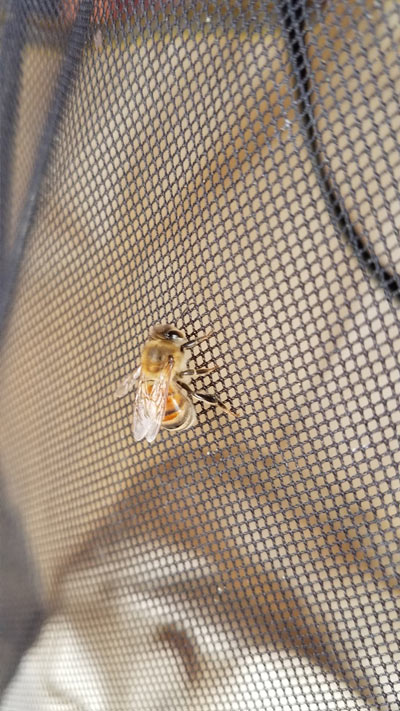
Keep your cool and don’t freak out if a bee goes inside the veil. In the apiary or near hives, never remove the veil. When a bee enters the veil, it usually does so because it is unhappy, and there may be many more bees attempting to do the same thing. Bees may still follow you even when you are far from the hive or cluster of hives, therefore taking off the veil will result in difficulties. Aim a few puffs of smoke around the head and face if there aren’t too many bees pursuing, then enter your car while wearing the veil. Allow any bees inside the car to fly out the open windows as you drive away. Once every supporter has left,
Another way to deal with this situation
Squash the bee in the veil before it gets a chance to sting you as an alternate faster and more effective solution. Avoid hesitancy; if you hesitate, the bee might have time to sting your palm or fingers. Bee gloves with arm gauntlets attached shield the hands from bee stings and stop them from climbing up the arm into the sleeve. If crushed by the movement of the cloth, a bee that has crawled inside the sleeve can sting. In addition to leather gloves, producers’ equipment for beekeepers also carries vinyl gloves. Rough leather gloves can irritate bees and are harder to clean than smooth vinyl gloves.
Do not forget to read our article What should you know about Nectar and Pollen Plants as a beekeeper
🛒 Mentioned Gear & Resources
- sturdy, tapered square folding wire veil Store / Gear
Found this guide useful? Share it as a reference!
Important Copyright Notice
All rights reserved to Bees Partners © 2026. Copying, republishing, translating, or extracting more than 10% of this material is strictly prohibited without prior written consent. For commercial or academic usage, please reach out via email: [email protected].