Article Statistics
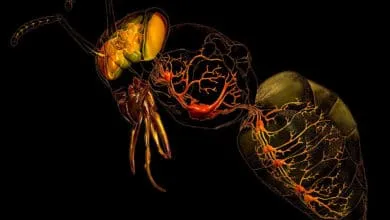
How The secret life of honeybees look like?
Honeybees and people have a tight association dating back to the Middle Ages, when bees were captured and raised for their priceless and delectable honey. Although the wild honeybee was also losing its natural home as the woodlands in which it resided were being cleared, over time the captive honeybee started to surpass it. Then, in the late 1940s, an outbreak of the fatal parasite Varroa mite hit African beekeepers, and it soon moved to hives in Europe and the Americas.
what about now?
Almost all commercial bee colonies throughout the world are currently Varroa-infested, which calls for treatment to avoid total colony collapse. People believed that the colonies of wild honey bees must have likewise been attacked, died, and vanished from their habitat in the forests of Europe due to the widespread spread of Varroa. Therefore, Benjamin Rutschmann and Patrick Kohl, two PhD researchers at the University of Würzburg in Germany, had low expectations going into their quest for wild honeybees. In the Hainich woodland in northwest Germany, they hung artificial feeders to entice honeybees. They then followed nectar collectors back to their hive. They were surprised to see that in this old beech woodland, some natural colonies still persisted.
Rochman and Cole discovered that one of the only places in these forests that offers ample space for bees to establish their food stores for the lengthy winter months is abandoned tree hollows carved by the black woodpecker (Dryocopus martius), where wild bees more frequently nest. In the Hennich Forest and the Swabian Alb Biosphere Reserve in southwest Germany, researchers watching black woodpeckers have been able to pinpoint the locations of roughly 500 vacant tree hollows. Every year, we inspect each of these trees, explains Rochman. Because around 10% of all these woodpecker cavities are occupied by honeybees in the summer, “we can find two honeybee colonies a day.”
They hypothesized, based on their data, that there may be thousands of wild honeybee colonies living in the forests of Germany. However, as they are most likely descended from their swarms that fled from commercial beehives and settled in the forest, these bees are not the robust survivors of an ancient breed of wild bees. Rochman believes they develop into self-sufficient, long-lasting wild communities. He remarks, “It seems really challenging for the bees.”
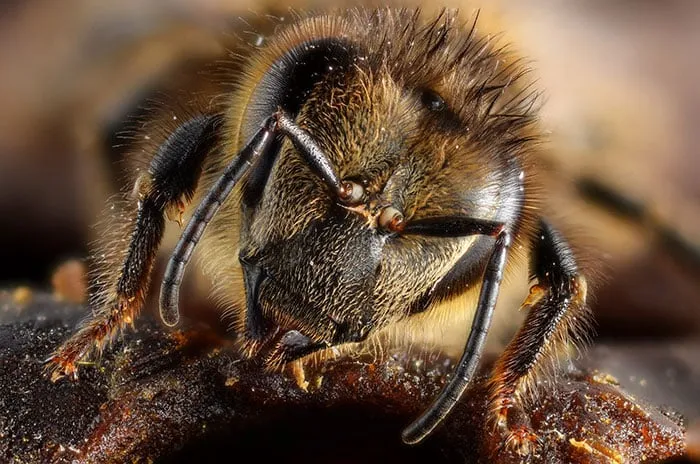
how honeybees look like in beech wood?

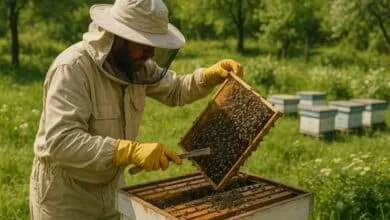
Detailing research on wild honey bee colonies is a difficult task. Between 8 to 80 meters above the ground, tree cavities can be found, therefore in order to examine them, researchers must climb trees. In order to gain a better view, photographer Ingo Arndt attracted a nearby colony to a downed beech tree that he dragged to his backyard, where he then erected a semi-natural nest. He took more than 60,000 pictures showing behaviors that were previously only seen in commercial honey bee colonies during the course of the six-month experiment.
For instance, during the initial stages of honeycomb construction, it was common to observe the workers linking their feet together to make a lengthy chain. Adam Hart, an entomologist and professor of communications at the University of Gloucestershire, claims that they are frequently called festooning bees. It is still a mystery as to why bees create this chain, despite the various theories that have been put up, such as using it as a framework for a forming disc or as a technique to measure area. In contrast to the typical chain width of one bee, Arendt’s semi-normal cell showed more complex chain-forming behaviors.

A sort of sack-like collection of live bees develops tangled up on the cavity’s roof as bees pitch their combs in three dimensions inside a tree cavity, according to Jürgen Tautz, Emeritus Professor of Honeybee Biology at the University of Würzburg. The meshes of the network might be very close together or very far apart depending on the situation. Tautz theorizes that this bee net might serve as protection against intruders and as a way to regulate the environment inside the tree hollow as it remains in place long after the honeybees have finished building their comb.
📚 References & Cited Sources
- University of Würzburg Source
Found this guide useful? Share it as a reference!
Important Copyright Notice
All rights reserved to Bees Partners © 2026. Copying, republishing, translating, or extracting more than 10% of this material is strictly prohibited without prior written consent. For commercial or academic usage, please reach out via email: [email protected].